What Public Relations Taught Me About Understanding Stakeholders
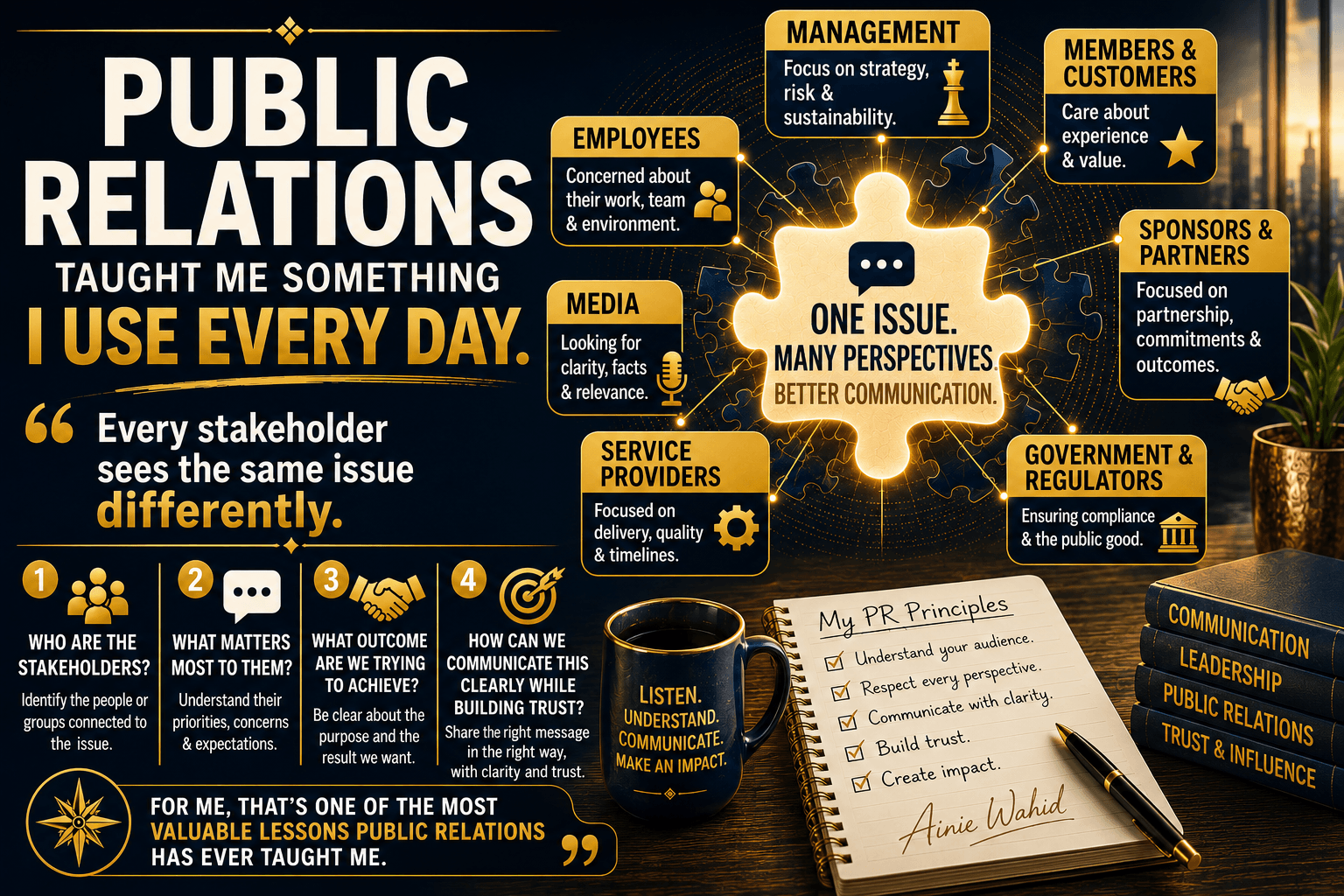
Public Relations taught me something I use every day. And interestingly, it has very little to do with media relations. One of the greatest lessons PR has taught me is this:
Every stakeholder sees the same issue differently.
Over the years, I have worked with Committee Members, Management, employees, Members, media, sponsors, government agencies, service providers and the public.
They may all be looking at the same situation, but they are not necessarily seeing the same thing. Each stakeholder has different expectations. Different priorities. Different concerns.
And if we communicate with everyone in exactly the same way, there is a good chance that someone will feel unheard. That is why I have always believed that Public Relations is so much more than writing.
It teaches us to understand the audience before we craft the message.
The Same Issue, Different Perspectives
Think about almost any organisational decision. Management may be considering operational requirements, cost, risk or long-term sustainability.
Employees may be thinking about how the decision affects their responsibilities or working environment. Members or customers may be primarily concerned about their experience. Service providers may be focused on implementation, timelines and contractual obligations. Government agencies or regulators may view the same matter through the lens of compliance and governance.
Everyone is looking at the same issue. But everyone is looking at it from a different position. That does not necessarily mean one perspective is right and another is wrong. It simply means that perspective shapes what matters to us.
Recognising this does not mean changing the facts for different audiences. The facts should remain consistent.
What changes is our understanding of what each stakeholder needs to know, what may concern them and what context will help them understand the situation..
Four Questions I Keep Coming Back To
This mindset has helped me far beyond communications. Whether I am preparing executive papers, facilitating meetings, managing projects or dealing with sensitive issues, I find myself returning to the same four questions.
1. Who are the stakeholders?
Start by identifying the people or groups connected to the issue. Some may be directly affected, while others may have an interest in the decision, responsibility for its implementation or influence over the eventual outcome.
Knowing who the stakeholders are helps us recognise that there may be perspectives beyond our own.
2. What matters most to them?
Different stakeholders care about different things. One group may be concerned about cost. Another may care about service quality, timing, fairness, operational impact, reputation or compliance.
Understanding those priorities helps us anticipate concerns rather than waiting for them to emerge after a message has already been communicated.
3. What outcome are we trying to achieve?
Good communication needs purpose. We may be trying to inform, explain, seek approval, resolve a concern, manage expectations, encourage action or build consensus.
Being clear about the intended outcome helps us decide what information is necessary and how best to present it.
4. How can we communicate this clearly while building trust?
Clarity matters, but so does trust. A message can be technically correct and still fail if people feel their concerns have been ignored.
Good communication therefore requires more than accuracy. It requires context, appropriate tone, transparency and an understanding of the people receiving the message.
These four questions may appear simple, but I have found them remarkably useful. They have made me a better communicator. More importantly, they have helped me become a better collaborator.
Understanding the Audience Changes the Message
One of the easiest mistakes in communication is to begin with: “What do we want to say?”
Public Relations taught me to begin somewhere else: “Who are we speaking to?”
The distinction matters. Understanding the audience does not mean manipulating the message or telling different people different versions of the truth. It means recognising that information becomes meaningful when people understand how it relates to them.
Senior management may require strategic implications and risks. An operational team may need responsibilities, processes and timelines. Members or customers may simply need to understand what is changing, why it is changing and how it affects them.
The underlying facts remain the same. The communication becomes more relevant.
We All Have Stakeholders
Stakeholder understanding is not something that belongs exclusively to Public Relations professionals. Regardless of our role, we all have stakeholders.
Someone working in Human Resources communicates with employees, management, candidates and regulators. Finance works across departments, management, auditors, vendors and financial institutions. Operations interacts with employees, customers, suppliers and service providers. IT works with users, management, vendors and security teams. Marketing communicates with customers, sales teams, agencies, partners and the wider market.
Different profession. Different stakeholders. Same fundamental challenge: We need to understand people as well as we understand the task. Technical expertise may tell us what needs to be done.
Stakeholder understanding helps us determine how to communicate it, how to collaborate around it and how to bring people along.
Listening Is Part of Communication
There is another side of stakeholder communication that is sometimes overlooked. Listening.
We often think of communication as writing, speaking, presenting or distributing information. But stakeholder understanding requires us to listen as well.
Questions, feedback, objections and even complaints can tell us something valuable. They may reveal that information was unclear. They may expose expectations that were never properly addressed. Or they may introduce a perspective we had not previously considered.
Listening does not mean agreeing with everyone. And understanding stakeholders certainly does not mean trying to make everyone happy.
It means understanding different perspectives well enough to respond thoughtfully, manage expectations responsibly and make better-informed decisions.
A Lesson That Goes Beyond Public Relations
The longer I work in communications, the more I appreciate that some of the most valuable lessons from Public Relations have very little to do with publicity. They are lessons about people.
About listening. About perspective. About relationships. About understanding what matters to someone before deciding how to communicate with them.
The tools we use will continue to change. The platforms will change. Technology and artificial intelligence will continue to transform how quickly we research, write, analyse and distribute information. But the human element remains.
People want to understand what is happening. They want to know how it affects them. And they want to feel that their perspective has at least been considered.
That is why I keep coming back to a simple principle:
Understand your audience.
Craft the right message.
Build trust.
Create impact.
Before asking: “What should we say?”
Perhaps we should first ask:“Who are we speaking to, and what matters to them?”
For me, that remains one of the most valuable lessons Public Relations has ever taught me.