Multitasking vs Multi-Skilled: How AI Changes the Equation
For years, we’ve praised people for being “great multitaskers.” But perhaps we’ve been celebrating the wrong thing.
The modern workplace doesn’t simply require people who can juggle multiple tasks. Increasingly, it requires people who are multi-skilled… professionals capable of applying knowledge across disciplines, adapting quickly and connecting ideas that traditionally belonged to separate functions. And now, artificial intelligence is changing what those people can accomplish.
Not because AI suddenly makes the human brain capable of doing ten things simultaneously. But because it can help us manage the complexity surrounding those ten things.
Multitasking and Multi-Skilling Are Not the Same
A multi-skilled professional possesses knowledge and capabilities across different disciplines. They may move between communications, operations, finance, marketing, project management, customer service or technology because they understand the principles, expectations and standards required in those areas.
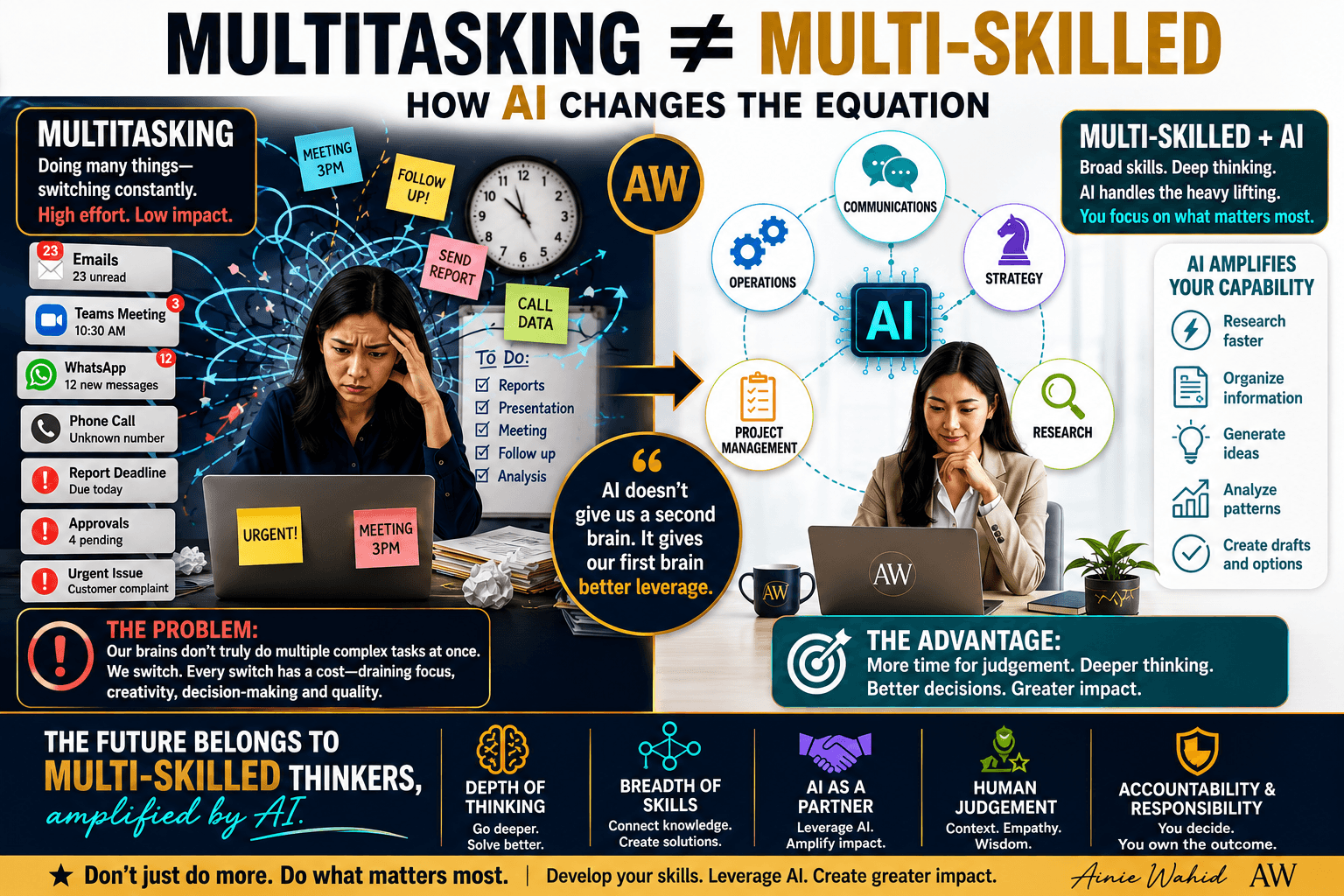
A multitasker is doing something different. They are switching between emails, meetings, reports, phone calls, messages, approvals and unexpected problems… sometimes within the same hour.
One describes the breadth of our capabilities. The other describes the number of demands competing for our attention.
That distinction matters.
Our attention is finite. Constantly moving between complex tasks can fragment concentration and make it harder to think deeply.
Being capable of doing many things does not mean we should attempt to do them all at exactly the same time.
Then AI Entered the Workplace
This is where I believe AI changes the equation. AI doesn’t eliminate the limits of human attention. What it can do is reduce some of the cognitive and administrative load surrounding our work.
A communications professional might use AI to organise research before developing a strategy. A project manager might use it to summarise information scattered across documents before identifying the next action. A manager working across several portfolios might use AI to structure ideas, compare information, prepare an initial analysis or turn unstructured notes into something easier to evaluate.
The professional still needs to understand the subject. They still need judgement. They still need to recognise when something is wrong. And they remain responsible for the final decision. But they don’t necessarily have to begin every task from a blank page.
That changes something important.
AI Can Amplify Multi-Skilled Professionals
I believe one of AI’s greatest workplace advantages may not be replacing individual skills. It may be connecting them.
Imagine someone who understands communications, operations and project management. Without AI, that person already possesses valuable cross-functional capability. With AI, they may be able to research faster, organise information more efficiently, explore alternatives, identify patterns and produce first drafts that give them more time for higher-value thinking.
Their expertise hasn’t disappeared. It has gained leverage. And this is why I believe AI could make multi-skilled professionals particularly valuable in the future workplace.
The more you understand, the better questions you can ask. The better questions you ask, the more effectively you can use AI. And the more effectively you use AI, the more time you can potentially redirect towards the things machines still cannot simply take responsibility for:
Judgement. Context. Creativity. Empathy. Accountability.
But There Is a Trap
AI can also make it dangerously easy to take on more. If something that previously took three hours can now be completed in one, organisations may be tempted to fill the remaining two hours with even more tasks. Eventually, efficiency becomes workload expansion.
That isn’t necessarily progress. Technology should help people work better, not merely help them become busier at greater speed.
The goal shouldn’t be: “How much more can one person handle?”
It should be: “How can technology free people to spend more time on work that genuinely requires human thinking?”
That distinction will become increasingly important.
The Future Belongs to Multi-Skilled, AI-Enabled Thinkers
I don’t believe the future belongs to the person who can keep twenty browser tabs open while answering WhatsApp messages during a Teams meeting and writing a report. 😂
That isn’t necessarily productivity. Sometimes, that’s simply survival.
I believe the greater advantage will belong to professionals who develop breadth without sacrificing depth.
People who understand multiple disciplines. People who can connect information across functions. People who know when to think for themselves and when technology can assist them. People who use AI not as a substitute for knowledge, but as an amplifier of capability.
Because AI doesn’t give us unlimited capacity. And it doesn’t remove the need for concentration. But used intelligently, it can help a multi-skilled person spend less energy managing the mechanics of work and more energy applying the judgement behind it. Perhaps the future doesn’t belong to the best multitaskers after all.
It belongs to the best multi-skilled thinkers, amplified by AI.