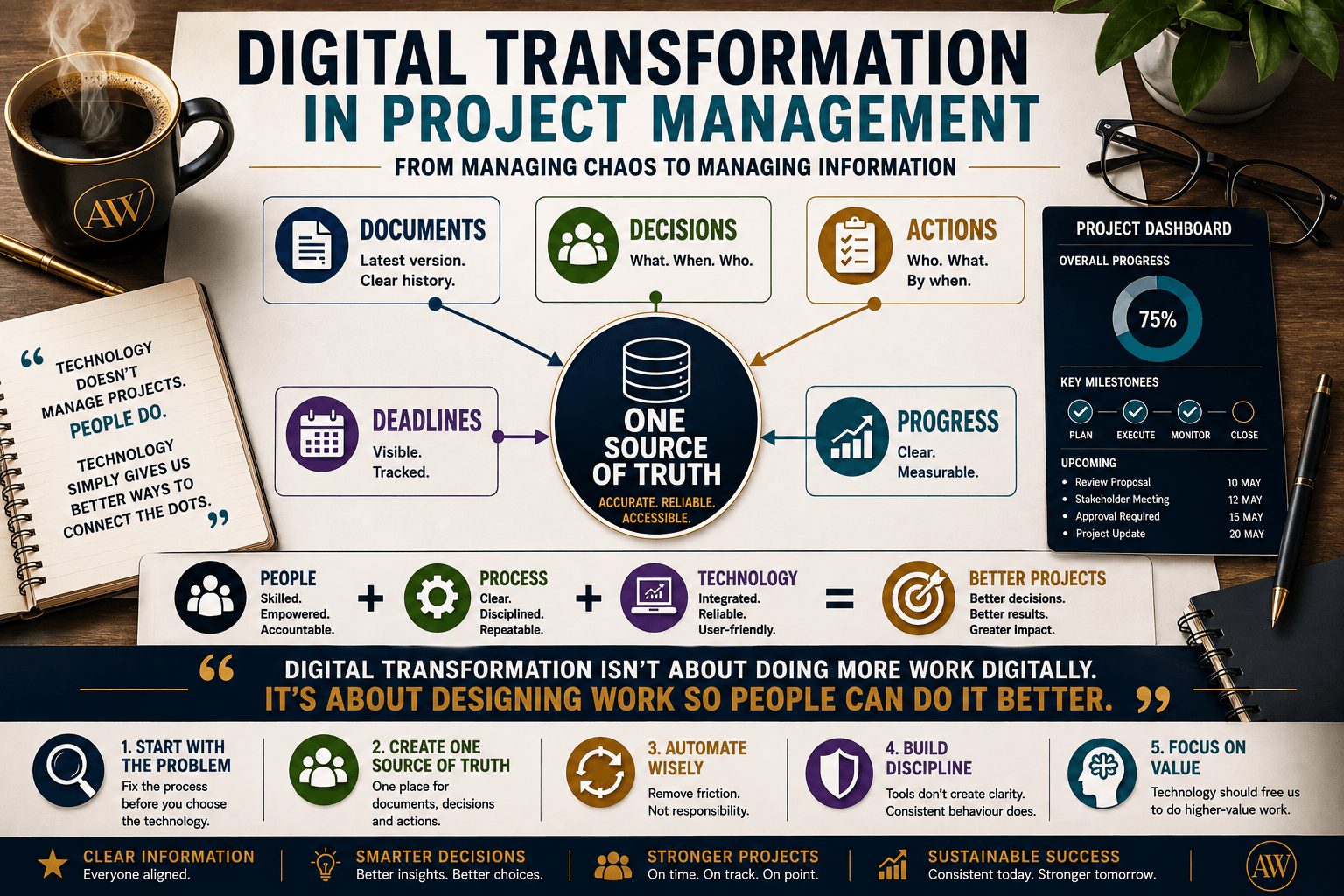
Digital Transformation in Project Management: From Managing Chaos to Managing Information
Some projects don’t just test your skills. They test your resilience.
Documents multiply. Amendments arrive. Meetings lead to more meetings. Phone calls create new action items. Decisions change earlier decisions. Deadlines continue moving closer while information becomes scattered across emails, messages, documents and conversations.
Anyone who has managed a complex project knows the feeling. You can spend an enormous amount of time simply trying to answer three questions:
What changed?
Who needs to act?
What happens next?
And that is where I believe digital transformation can fundamentally change project management.
Digital Transformation Isn’t About Adding More Technology
When we hear “digital transformation”, it is easy to imagine sophisticated systems, expensive platforms or another piece of software employees need to learn. But transformation shouldn’t begin with the technology. It should begin with the problem.
If a project team is constantly searching through emails for the latest document, the problem is not a lack of email.
If five different versions of the same document are circulating, the problem is not that people need another communication channel.
If decisions are made during meetings but nobody can easily trace what was decided three weeks later, the problem is not necessarily the people. The problem may be the process.
Digital transformation should therefore ask: How can technology make the flow of information clearer, faster and more reliable?
From Documents to Information
Traditional project management can easily become document-heavy. Reports, Minutes, Proposals, Spreadsheets, Presentations, Amendments, Approvals.
All of these documents may be necessary. But managing documents is not the same as managing information. A digitally enabled project should make it easier to understand:
What is the latest version?
What has changed?
Who approved it?
What decisions remain outstanding?
Who owns the next action?
When is it due?
The goal isn’t to eliminate documentation. The goal is to make information easier to find, understand, track and act upon.
One Source of Truth Changes Everything
One of the simplest but most powerful principles in digital project management is creating a single source of truth.
Instead of information living across someone’s inbox, another person’s WhatsApp messages, several folders and three versions of a spreadsheet, the project needs one reliable place where the current position can be understood. That might include:
Document control — one current version with a clear revision history.
Decision tracking — what was decided, when and by whom.
Action tracking — who is responsible, what needs to happen and by when.
Project visibility — milestones, dependencies, risks and progress accessible to the people who need them.
Knowledge continuity — information remains available even when people change roles or leave the project.
Suddenly, technology isn’t simply digitising paperwork. It is creating organisational memory.
Automation Should Remove Friction, Not Responsibility
This is also where automation, and increasingly AI can help. Routine reminders can be automated. Meeting notes can be organised more quickly. Large amounts of information can be summarised. Documents can be compared to identify changes. Project dashboards can surface deadlines and outstanding actions. But technology should not make the decisions for us.
A system can tell us that a deadline has been missed. It cannot always understand why it was missed, what organisational sensitivities are involved, or which compromise creates the best outcome. That still requires human judgement.
So the goal is not: Human → Technology
It is: Human + Technology → Better Project Management
Digital Transformation Also Requires Discipline
There is another lesson I’ve learned. Even the best system fails if people don’t use it properly.
A project management platform cannot create clarity if half the team continues storing documents somewhere else. A dashboard is useless if nobody updates it.
Version control doesn’t work if people keep downloading documents, renaming them and circulating new copies independently.
Digital transformation therefore requires more than implementation. It requires behavioural change.
People need to understand not only how to use the system, but why the discipline matters. This is where leadership, communication and technology intersect.
Technology Should Give Us More Time to Think
The greatest benefit of digital transformation shouldn’t simply be that we can complete more tasks. It should be that we spend less time managing administrative chaos.
Less time searching. Less time checking which document is correct. Less time repeating information. Less time reconstructing decisions from old emails.
And more time analysing. Solving problems. Managing risks. Making decisions. Communicating. Leading. Because project management isn’t really about managing documents.
It’s about managing decisions, people, information and progress.
Technology simply gives us better ways to connect them. And perhaps that is the real promise of digital transformation in project management:
Not doing more work digitally. But designing work so that people can do it better.


