When Technology Removes the Queue But Not the Anxiety
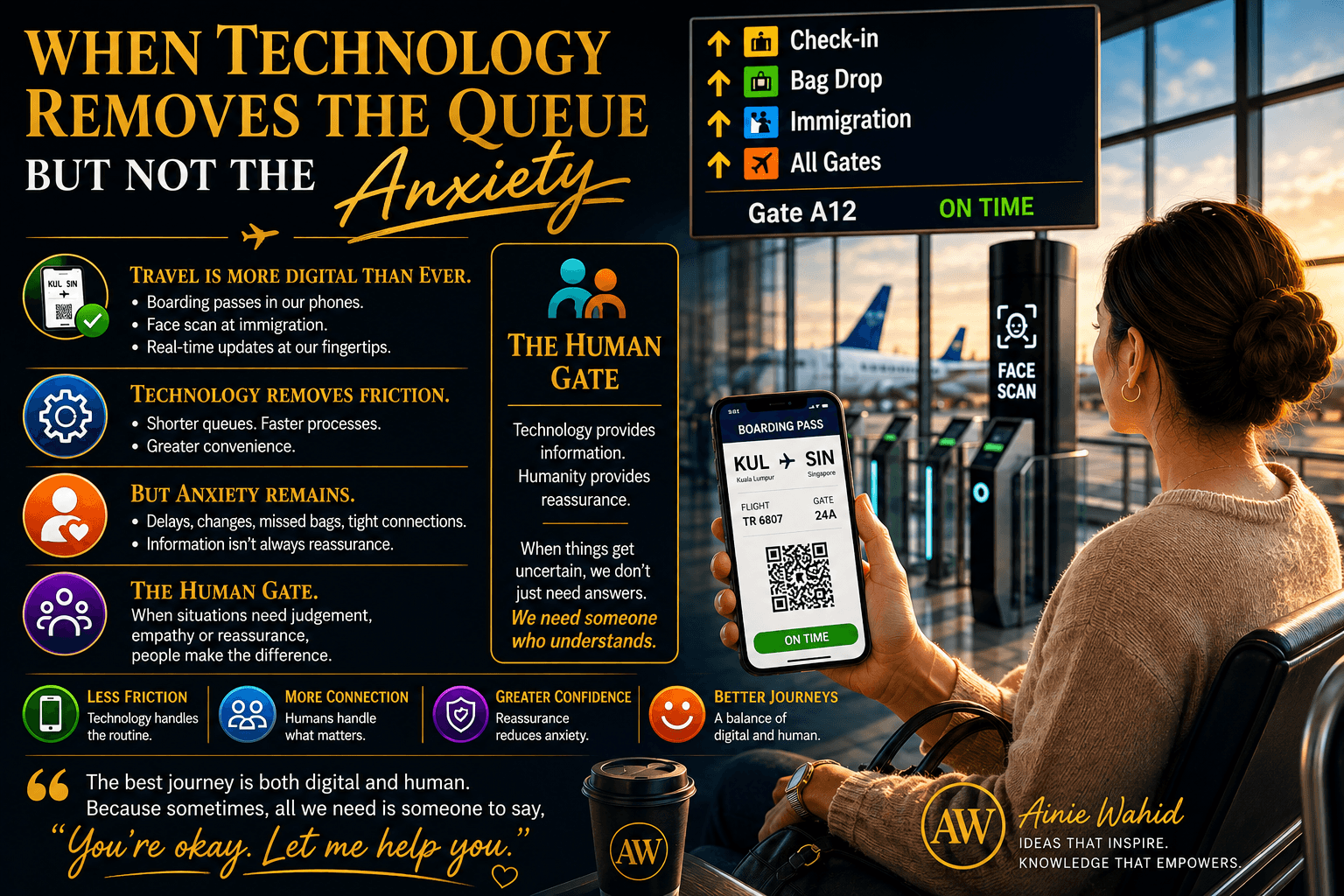
Travel has probably never been more technologically convenient. My boarding pass lives in my phone. I can check in without speaking to anyone.
At some airports, I can drop my own bag, pass through immigration using facial recognition, follow digital signs to my gate, order food through an app and receive real-time notifications if my flight changes.
In theory, travelling should feel easier than ever. And in many ways, it does.
The queues are shorter. Information travels faster. Processes that once required several pieces of paper can now happen with a few taps on a screen. Yet I’ve noticed something interesting.
Technology can remove friction without necessarily removing anxiety.
You can have your boarding pass safely stored in your phone and still check it three times.
You can see ON TIME displayed clearly on the departure board and still glance at the gate every few minutes.
You can receive an app notification telling you exactly where to go and still feel strangely reassured when an actual human being behind the counter says:
“Yes, you’re at the right gate.”
Why? Because efficiency and reassurance are not the same thing.
Travel Has Become Increasingly Self-Service
Think about how much of the modern travel experience we now manage ourselves. We book our own flights. Choose our own seats.Check ourselves in. Print our own luggage tags. Scan our own boarding passes. Navigate airports using digital maps. Track our flights. Manage itinerary changes through apps.
Technology has given travellers extraordinary independence. And I appreciate it. I don’t particularly miss standing in a long queue simply to receive a piece of paper someone can now send directly to my phone. But there is an interesting trade-off.
As technology removes more human interactions from the journey, travellers are increasingly expected to interpret information and solve problems themselves. That works beautifully when everything goes according to plan.
Then the departure board suddenly says:
DELAYED.
Or your gate changes. Your bag doesn’t appear. Your connection becomes dangerously short. The app isn’t updating. Your passport won’t scan. And suddenly the most valuable technology in the airport may be…
a person who knows what to do.
Automation Works Best When Nothing Unexpected Happens
Technology is extraordinarily good at managing predictable processes. If A happens, do B. If the flight changes gates, send a notification. If boarding begins, update the app. If a passenger scans the correct boarding pass, open the gate.
Efficient. Consistent. Fast.
But human beings don’t experience travel purely as a sequence of transactions. We experience uncertainty. We worry. We misunderstand things. We become tired. Sometimes we panic. And occasionally we simply need someone to look at the situation and say:
“Don’t worry. Here’s what we’re going to do.”
No amount of automation makes that sentence unnecessary.
The Human Gate
Perhaps every highly automated experience needs what I think of as a human gate. Not a person standing unnecessarily inside every process. That would defeat the purpose of automation.
A human gate is the point at which technology recognises:
This situation now requires judgement, empathy or reassurance.
Most travellers don’t need assistance when everything is working. But when something stops working, the ability to reach a competent human being quickly becomes enormously important.
And I think that principle extends far beyond airports.
What Travel Technology Taught Me About Communication
We often make a similar mistake when introducing technology into organisations. We assume that because information has been delivered, communication has happened.
An email was sent. A dashboard was updated. An FAQ was published. A chatbot answered the question. A system notification appeared.
Technically, information was communicated. But did the person feel reassured? Did they understand what the change means for them? Do they know what happens next? Do they know who to approach when their situation doesn’t fit neatly into the system?
That is where communication leadership becomes important.
Automation can distribute information.
But communication must still create understanding, confidence and trust.
Digital Doesn’t Have to Mean Impersonal
None of this means we should resist travel technology. Quite the opposite. I love the convenience. I love having everything on my phone. I love not having to search frantically through my handbag for a boarding pass I was absolutely certain I put somewhere safe five minutes earlier. 😂
Technology should remove unnecessary friction. Let machines handle repetitive transactions. Let systems process predictable information. Let automation eliminate queues that don’t need to exist. But perhaps the best technology doesn’t remove humans completely.
It removes the unnecessary interactions so humans have more capacity for the interactions that actually matter.
That is a very different philosophy of digital transformation.
The Best Journey Is Both Digital and Human
The airport of the future may become even more automated. Biometrics may replace more documents. AI may anticipate disruptions before passengers even realise something has changed.
Digital identities may make borders increasingly seamless. And perhaps one day the entire journey from entrance to aircraft will happen without needing to show a document to another person.
That may be progress. But I hope there will always be a human somewhere nearby. Not because technology has failed. But because sometimes reassurance requires more than information.
Sometimes we need judgement. Sometimes we need empathy. And sometimes, despite all the technology surrounding us, we simply need another human being to say:
“You’re okay. Let me help you.”
Perhaps that is the lesson travel technology continues to teach me.
Technology can remove the queue. But humanity removes the anxiety.