Work-Life Balance Is Not a Destination
We often talk about work-life balance as though it is somewhere we eventually arrive. A point where everything is perfectly balanced. Where work never spills into personal time. Where every day is neatly divided between responsibilities and rest. Where we somehow manage to give exactly the right amount of attention to our careers, families, relationships, health, interests and ourselves. It sounds wonderful.
I’m just not sure real life works that way. Life moves in seasons. There will be seasons when work asks more of us. There will be projects that require longer hours, responsibilities that cannot simply be postponed, and periods when professional commitments temporarily take up more space than we would normally allow. There will also be seasons when family needs more of us.
Someone may need our time, our presence or our support. Priorities shift, sometimes without warning, and the things that seemed urgent yesterday suddenly become much less important.
And then there are seasons when the person who needs our attention the most… is us.
Perhaps Balance Was Never Supposed to Mean 50/50
I think one of the problems with the idea of work-life balance is the word balance itself. It can create the impression that everything should somehow remain perfectly equal. But balance isn’t necessarily equality.
Imagine standing on a moving surface. Staying balanced doesn’t mean remaining perfectly still. You adjust. You shift your weight. You respond to what is happening around you.
Perhaps life works the same way. Some weeks may be heavily weighted towards work. Another week may belong almost entirely to family.
Sometimes we need to step away, rest, travel, think, or simply do absolutely nothing productive for a while. None of those moments necessarily means we’ve failed at balance.
The adjustment may actually be the balance.
The Person We Often Leave Off the List
Somewhere between meeting deadlines, fulfilling responsibilities and showing up for everyone else, it is remarkably easy to forget one person. Ourselves.
We think about what our organisations need. What our teams need. What our families need. What our friends need. What needs to be completed before tomorrow morning. And sometimes our own needs quietly move further and further down the list.
Yet the way we care for ourselves eventually affects every role we hold. As professionals. As leaders. As partners. As parents. As friends. As human beings.
We cannot completely separate the person who arrives at work from the person who exists outside it. Eventually, one affects the other.
Taking Care of Yourself Isn’t the Opposite of Commitment
There can be a strange guilt associated with stepping away. We tell ourselves we should answer one more email. Finish one more document. Solve one more problem. Be available for one more person. And sometimes we should.
Responsibility matters. But responsibility without boundaries can quietly become depletion.
Taking care of yourself doesn’t mean you care less about your work. Rest doesn’t mean you’ve lost ambition. Making time for yourself doesn’t mean you’ve become less dependable.
Sometimes stepping away is precisely what allows us to return with greater clarity, patience and perspective.
Self-care doesn’t have to mean elaborate retreats or disappearing from responsibilities. Sometimes it simply means recognising:
I have reached my limit for today. And respecting it.
Different Seasons Require Different Priorities
I have also become more comfortable with the idea that priorities can change. What mattered enormously to us five years ago may not carry the same weight today.
Our responsibilities change. Our ambitions change. Our families change. We change.
That doesn’t necessarily mean we have become less driven. It may simply mean we have become clearer about what deserves our energy.
Perhaps maturity isn’t about learning how to fit everything into our lives. Perhaps it is partly about learning what deserves to be there in the first place.
And that requires us to keep asking ourselves: What needs me most right now?
Sometimes the answer will be work. Sometimes it will be someone we love. And occasionally, the answer needs to be: Me.
Balance Is Something We Keep Creating
Perhaps work-life balance isn’t a destination after all. There may never be a magical point where everything becomes perfectly organised and remains that way forever.
There will always be another deadline. Another responsibility. Another unexpected situation. Another season.
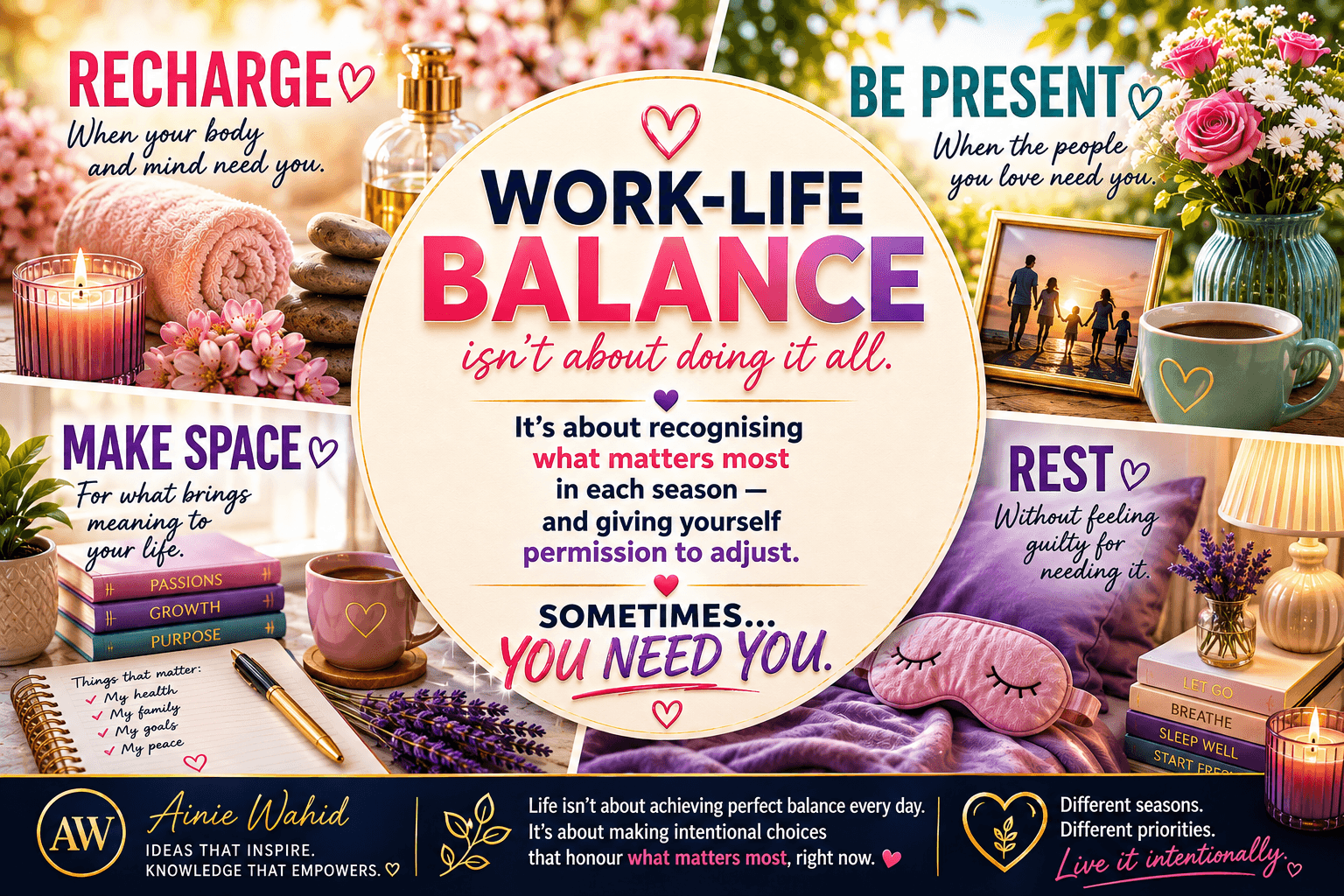
So perhaps the goal isn’t to find balance. It is to keep creating it.
To recognise when something has occupied too much space. To know when another part of our life needs more attention. To understand when to push.
When to pause. When to say yes. And when to say, not today.
That kind of balance is imperfect. It moves. It changes. It requires constant adjustment. But perhaps that makes it more human. And maybe the most important part of work-life balance isn’t balancing work and life at all.
It’s remembering to take care of the person trying to balance them both. You.