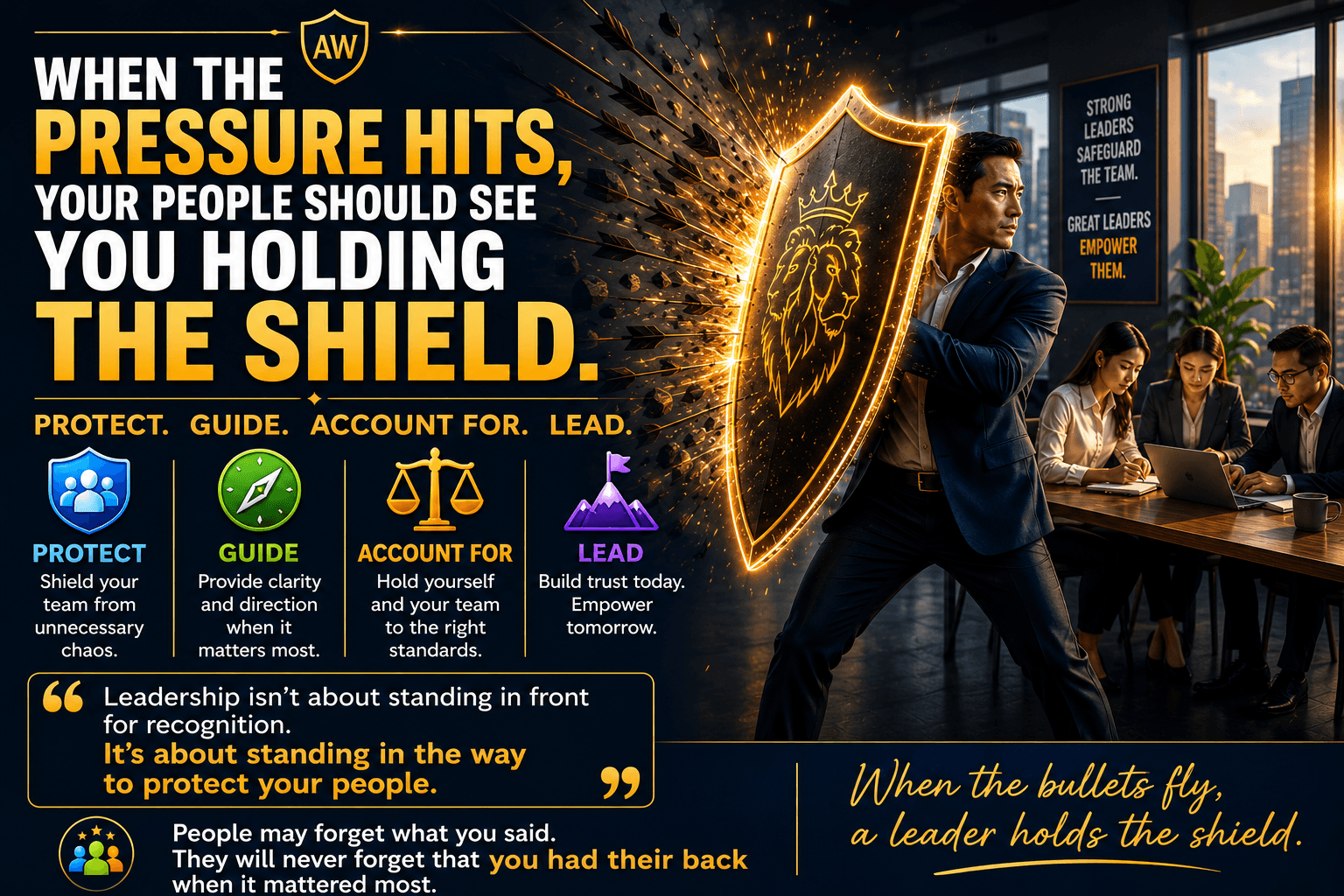
When Leadership Means Holding the Shield
When the world fires bullets, your people should see you holding the shield.
That, to me, is one of the clearest expressions of leadership. I used to think leadership was largely about having the answers. Being the person making the decisions.
Setting the direction.
Solving the problems.
Steering everyone towards the destination.
Experience has taught me something different. Sometimes, leadership has very little to do with being the person at the front. Sometimes, it means being the person willing to stand in the way.
Leadership Isn’t Always Visible
There was a situation I encountered that was tense, political and messy. I could see where it was heading. More importantly, I could see what would happen if my team became unnecessarily caught in the middle of it.
They would spend their energy responding to noise instead of doing their work. They would carry tension that wasn’t theirs to carry. And eventually, something that had little to do with their responsibilities could begin affecting their confidence, focus and morale. So I stepped in. I took the difficult conversations. I absorbed the noise.
I dealt with what needed to be dealt with and tried to create enough space for my team to continue doing their jobs without carrying someone else’s storm. There was nothing particularly glamorous about it.
No announcement.
No recognition.
No applause.
But something changed afterwards.
Trust.
You could feel it in the way people showed up. Not only for me, but for one another. And that experience changed the way I thought about leadership.
Protection Doesn’t Mean Hiding People From Accountability
There is an important distinction here. Protecting your team does not mean protecting people from the consequences of poor performance. It does not mean pretending mistakes did not happen. And it certainly does not mean shielding people from feedback they genuinely need in order to grow.
Good leaders still hold people accountable. But there is a difference between accountability and unnecessary exposure. If someone on my team makes a mistake, we address the mistake. If something needs improvement, we improve it.
But when external pressure, politics, confusion or conflict threatens to consume people who do not need to be carrying it, leadership sometimes requires someone to step forward and say:
“I’ll handle this.”
That is not weakness. It is responsibility.
The Shield Works Both Ways
There is another side to this. A leader cannot expect to protect the team publicly while blaming them privately whenever something goes wrong.
If we accept recognition when our teams succeed, we must also be prepared to accept responsibility when things become difficult. That doesn’t mean taking responsibility for everything personally. It means creating an environment where people know they will be treated fairly.
Where mistakes can be discussed without humiliation.
Where difficult conversations happen with dignity.
And where employees don’t spend their working day wondering whether their leader will disappear the moment pressure arrives. Because psychological safety isn’t created by posters on an office wall.
It is created through behaviour.
People Remember Who Stood Beside Them
Years later, employees may not remember every instruction we gave them. They may not remember every meeting. They certainly won’t remember every PowerPoint slide. But they will remember the moments when things became difficult.
They will remember whether their leader blamed them or guided them. Whether their leader disappeared or showed up. Whether their leader added to the pressure or helped them navigate through it. And they will remember whether, when the bullets started flying, they looked ahead and saw their leader holding the shield.
That is when I realised: Leadership isn’t about standing in front for recognition.
Sometimes, leadership is standing in the way to protect your people. And perhaps one of the greatest forms of trust a leader can earn is when their team knows:
When things become difficult, you won’t have to face them alone.