I Choose to Learn AI, Not Fear It
For a long time, technology was something many of us simply used.
We learned email.
We learned smartphones.
We learned social media.
We learned new software whenever work required it.
Then artificial intelligence arrived, and somehow the conversation became different. Suddenly, people were asking:
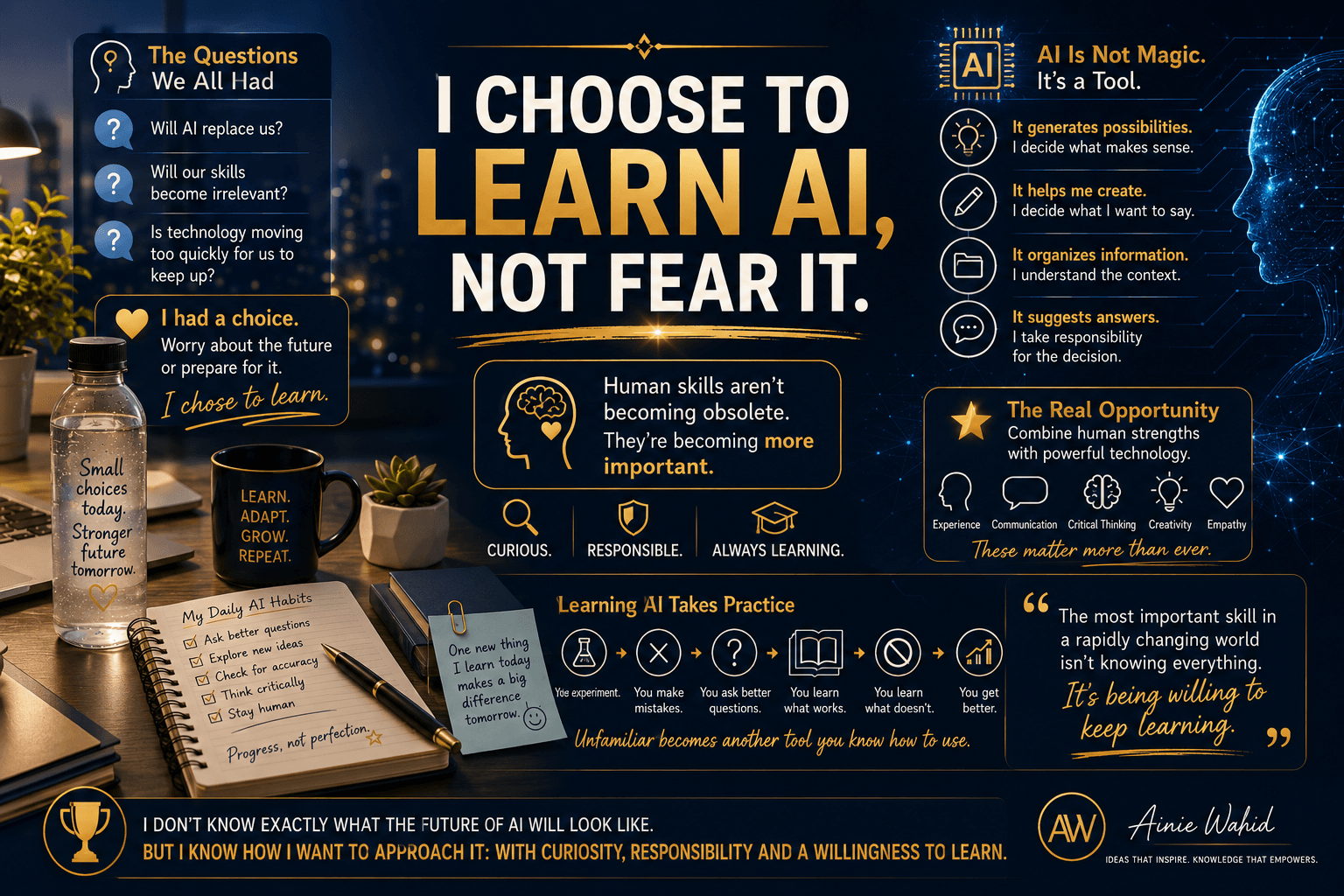
Will AI replace us?
Will our skills become irrelevant?
Is technology moving too quickly for us to keep up?
I understand those concerns. But somewhere along the way, I realised I had a choice.
I could spend my energy worrying about what artificial intelligence might change, or I could spend that same energy learning how to work with it.
I chose to learn. And that decision has changed the way I look at technology.
AI has become a tool I use to explore ideas, organise thoughts, research possibilities, improve productivity and approach familiar problems from different angles.
But the more I use it, the more convinced I become of something important:
AI does not remove the need for human judgement. It makes human judgement even more important.
A machine can generate possibilities. But I still have to decide what makes sense.
It can help me write. But I still need to know what I want to say.
It can organise information. But I still need to understand the context.
It can suggest an answer. But I remain responsible for deciding whether that answer is appropriate.
That is why I don’t see learning AI as abandoning the skills that brought us this far.
It is about adding another capability to them.
Communication still matters.
Experience still matters.
Critical thinking still matters.
Creativity still matters.
Human understanding still matters.
Perhaps even more than before. The real opportunity is learning how to combine those human abilities with increasingly powerful technology.
And just like every major technological change before it, becoming comfortable with AI requires something that isn’t particularly glamorous:
Practice.
You experiment.
You make mistakes.
You ask better questions.
You learn what works.
You learn what doesn’t.
And gradually, something unfamiliar becomes another tool you know how to use.
I don’t know exactly what the future of artificial intelligence will look like.
None of us does. But I know how I want to approach it.
Not with fear.
Not with blind enthusiasm.
But with curiosity, responsibility and a willingness to learn.
Because perhaps the most important skill in an age of rapidly changing technology isn’t knowing everything.
It’s being willing to keep learning.