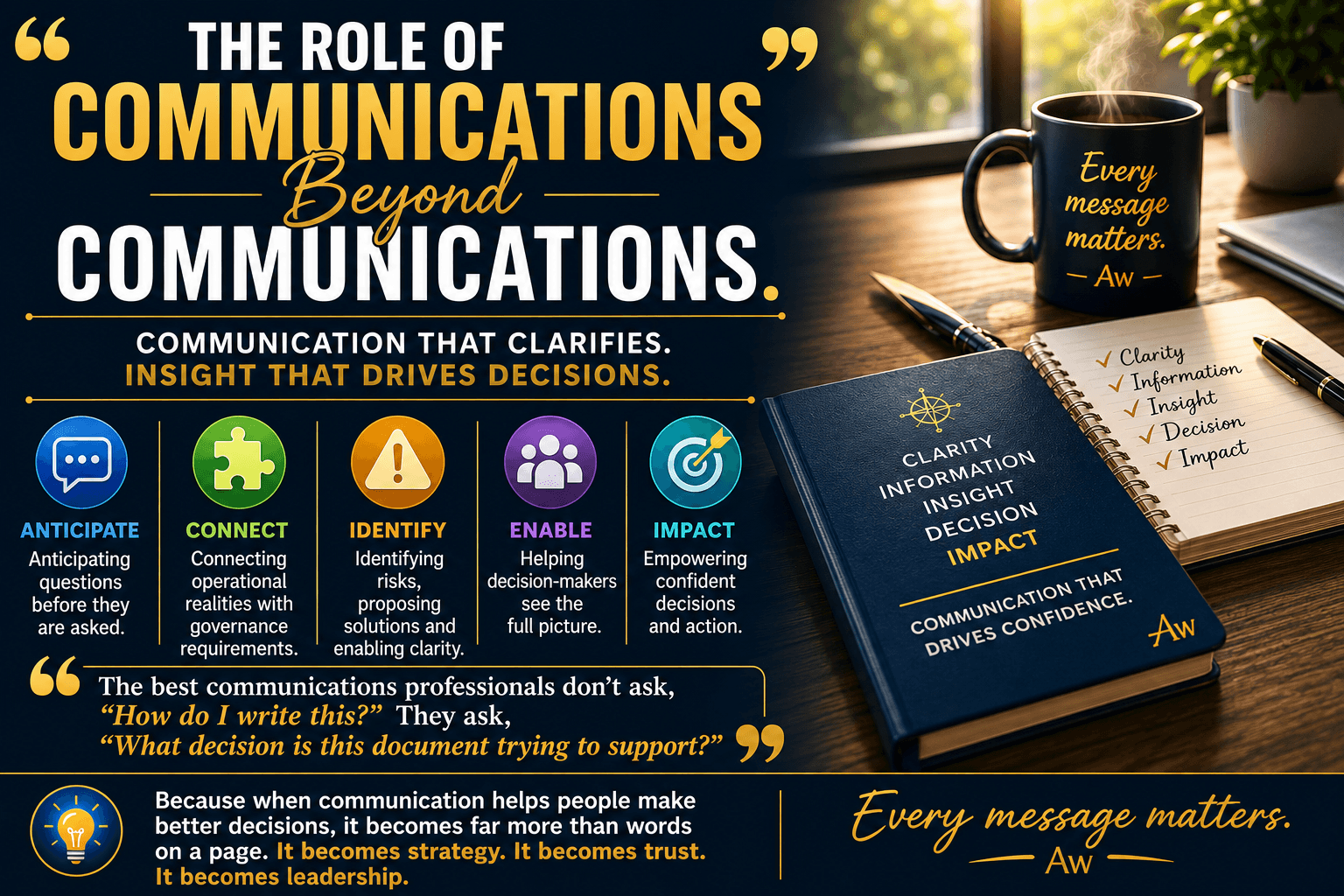
The Role of Communications Beyond Communications
There is a common perception that working in communications is primarily about writing. Writing media statements. Preparing speeches. Drafting announcements. Producing content.
Writing is certainly part of the profession. But over the years, I have come to realise that some of the most important work in communications happens long before the first sentence is written.
It happens when communication enables better decisions.
In my work, I can move between a press conference, meeting minutes, executive briefing papers, procurement matters, operational planning and Committee discussions.
On paper, these responsibilities may appear unrelated. In reality, they often serve the same purpose:
Helping decision-makers see the full picture.
Communication Is More Than Presenting Information
Good communication is not simply about taking information and making it sound better. It requires understanding what the information means, why it matters, who needs it and what decision needs to follow. That means anticipating questions before they are asked.
It means connecting operational realities with governance requirements. It means identifying potential risks, clarifying implications and helping people understand the available options. And sometimes, it means recognising that the most important message isn’t necessarily the most obvious one.
A communications professional therefore needs to think beyond: “What should I say?”
and begin asking: “What does this person need to understand in order to make the right decision?”
That is a very different question.
From Information to Insight
Information alone does not necessarily create clarity. A decision-maker can receive ten pages of information and still not know what needs to happen next.
The role of communications is therefore not simply to transfer information. It is to help transform:
Information → Context → Understanding → Decision → Action
Sometimes that means preparing a media statement. Sometimes it means drafting an executive paper. Sometimes it means producing accurate meeting minutes that clearly capture decisions and responsibilities. And sometimes it means explaining why an operational timeline, governance requirement or seemingly small detail could significantly affect an outcome.
The format changes. The purpose does not.
The Question I Believe Communications Professionals Should Ask
Before drafting an important document, I believe there is one question worth asking:
“What decision is this document trying to support?”
That question changes the way we communicate. It forces us to think about the audience. It makes us consider what information is essential and what is merely noise. It encourages us to anticipate concerns rather than simply react to them.
Most importantly, it shifts communications from being a production function to becoming a strategic function.
Because the best communications professionals do more than communicate what has already happened. They help organisations understand what needs to happen next.
And when communication gives people the clarity and confidence to make better decisions, it becomes far more than words on a page.
It becomes strategy.
It becomes trust.
It becomes leadership.